Most AI-detector comparisons are a year behind the models they are supposed to catch. So we built a fresh set — 522 English texts, 177,512 words: 251 written by humans, 271 generated by current and previous-generation LLMs — and on 27 August 2026 ran all of it through GPTZero, ZeroGPT and our own detector, tropa-2.
One verdict per detector per text. Every text and every score is public, so you can check any number below.
TL;DR
- Current models get past most detectors. On raw text from GPT-5.6, Claude Opus 5 / Fable 5, Gemini 3.6, Grok 4.6 and friends (n = 136), GPTZero labelled 41.9% as AI, ZeroGPT 11.8%, tropa-2 96.3%.
- Last year's models are a solved problem: GPTZero 100%, ZeroGPT 90%, tropa-2 100%. Detection difficulty is almost entirely a function of model recency.
- False positives: on 251 human texts, GPTZero accused none, tropa-2 one (0.4%), ZeroGPT seven (2.8%).
- Paraphrase is the hard case for everyone: when a current model rewrites a human text, GPTZero catches 2.0%, ZeroGPT 2.1%, tropa-2 74.0%.
- Caveat before you quote anything: the AI texts come from our own generation pipeline, so this sits closer to tropa-2's training distribution than to GPTZero's or ZeroGPT's.
The results
Share of texts labelled AI by each detector. For the human row that is the false-positive rate (lower is better); for the others it is the detection rate (higher is better). ZeroGPT returned nothing for 3 texts, so its column is over 519.
| Category | n | GPTZero | ZeroGPT | tropa-2 |
|---|---|---|---|---|
| Human (false positives) | 251 | 0.0% | 2.8% | 0.4% |
| AI, all | 271 | 47.2% | 23.4% | 93.4% |
| Current models, raw | 136 | 41.9% | 11.8% | 96.3% |
| Current models, paraphrase | 50 | 2.0% | 2.1% | 74.0% |
| Previous models, raw | 50 | 100% | 90.0% | 100% |
| Previous models, paraphrase | 35 | 57.1% | 2.9% | 100% |
The bottom two rows against the middle two are the whole story. Move up one model generation and GPTZero drops from 100% to 41.9% and ZeroGPT from 90% to 11.8%.
Per model: who gets caught
Raw, unparaphrased output from current models. Per-model n is small (1–18 texts), so read individual rows as directional.
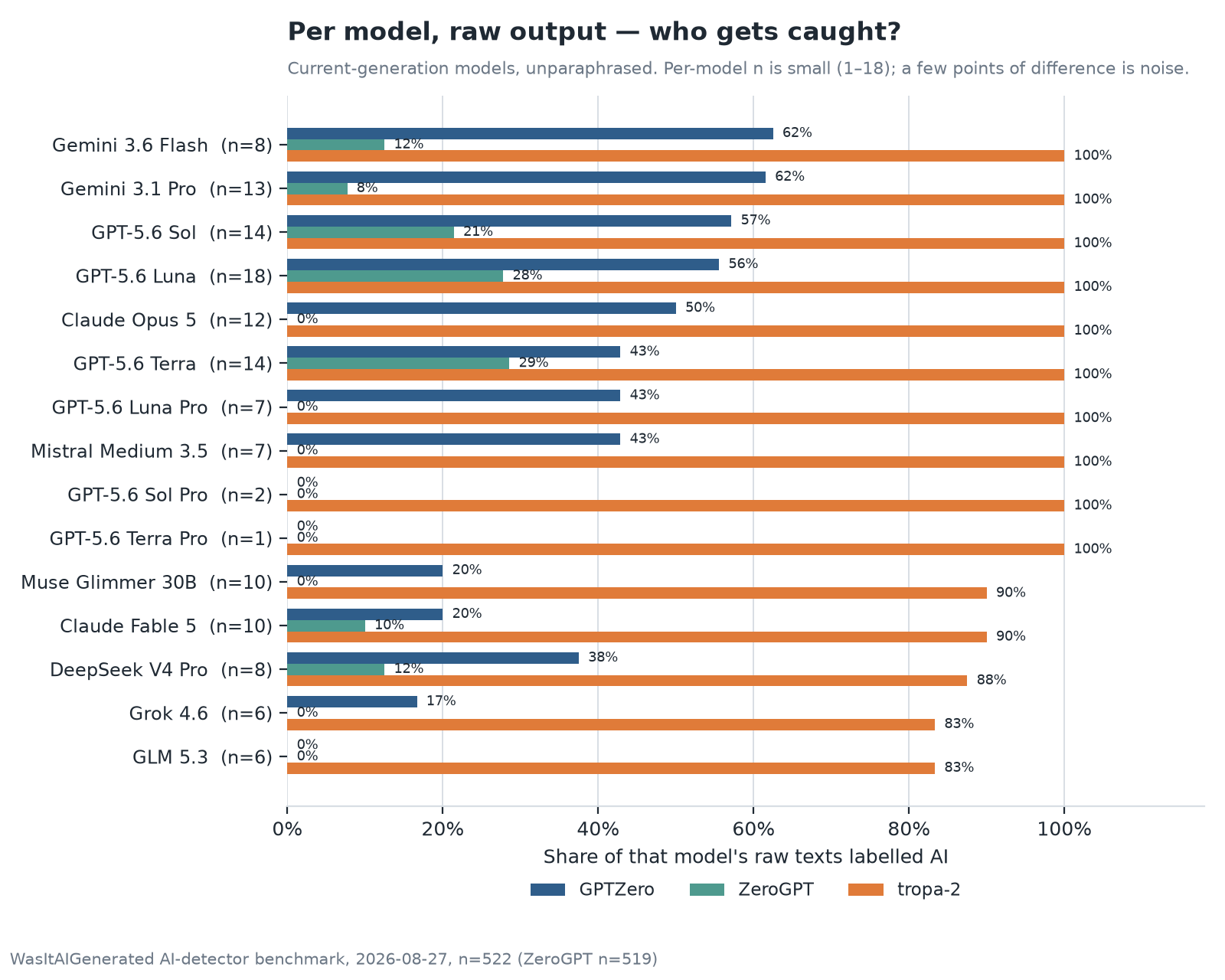
| Generator (raw, current) | n | GPTZero | ZeroGPT | tropa-2 |
|---|---|---|---|---|
| GPT-5.6 Sol | 14 | 57% | 21% | 100% |
| GPT-5.6 Luna | 18 | 56% | 28% | 100% |
| GPT-5.6 Terra | 14 | 43% | 29% | 100% |
| GPT-5.6 Luna Pro | 7 | 43% | 0% | 100% |
| Claude Opus 5 | 12 | 50% | 0% | 100% |
| Claude Fable 5 | 10 | 20% | 10% | 90% |
| Gemini 3.1 Pro | 13 | 62% | 8% | 100% |
| Gemini 3.6 Flash | 8 | 62% | 12% | 100% |
| DeepSeek V4 Pro | 8 | 38% | 12% | 88% |
| Mistral Medium 3.5 | 7 | 43% | 0% | 100% |
| Grok 4.6 | 6 | 17% | 0% | 83% |
| GLM 5.3 | 6 | 0% | 0% | 83% |
| Muse Glimmer 30B | 10 | 20% | 0% | 90% |
(GPT-5.6 Sol Pro and Terra Pro, n = 2 and 1, are in the chart but too small to tabulate.)
Models tuned for prose quality are the hardest for every tool: Claude Fable 5, Grok 4.6 and GLM 5.3 sit at the bottom across the board. Detecting GPT-5.6 text is not meaningfully harder than detecting Gemini output for GPTZero (43–57% vs 62%). Claude Opus 5 came in at 50% for GPTZero, 0% for ZeroGPT and 100% for tropa-2 on 12 texts.
False positives: the number that actually matters
A detector that flags real students is worse than useless, so this section matters more than the one above.
The 251 human texts span 12 domains — pre-2017 arXiv abstracts, CC-News, wikiHow, technical docs, Enron emails, Reddit ELI5, recipes, Gutenberg fiction, Poetry Foundation, Yelp reviews, web pages and 59 PERSUADE 2.0 student essays. GPTZero accused none of them. tropa-2 accused one: a short Enron email. ZeroGPT accused seven (3 recipes, and one each of poetry, technical docs, wikiHow and news).
251 texts is a small sample for a rate you want quoted in tenths of a percent, so we also ran tropa-2 over 3,000 student essays from PERSUADE 2.0 (grades 6–12, all human, none used in training). There it labelled 2.6% as AI; the median essay scored 13.7 out of 100.
We are not going to spin that. On this benchmark's 59 essays we saw 0%, but the 3,000-essay run puts the honest figure for student writing at roughly 1 in 40. AI detector false positives on student essays are a real risk with every tool on the market, ours included. No detector verdict should be the sole basis for an academic accusation.
How we ran it
Same texts, same day, default settings for every detector. Each tool's own verdict counts: GPTZero — its ai label (its third class, mixed, is a legitimate "partly AI" output; we count it as not AI here and report it in the FAQ). ZeroGPT — "AI/GPT generated" or "most of your text is AI/GPT generated" counts as AI; everything else, including "may include parts generated by AI", does not. tropa-2 — the "AI-generated" label the site shows, a score of 90 or more on its 0–100 scale.
The label comparison hides one trade-off: a detector can buy detection by tolerating more false positives. So for the tools that return a continuous score we also set the threshold on the 251 human texts such that at most one of them (0.4%) is labelled AI, and re-read detection at that threshold. tropa-2: 96.3% on current raw text, 74.0% on paraphrase. ZeroGPT's percentage: 5.1% / 2.1%. GPTZero has no document score to threshold. The ranking does not change.
Length mix: 379 short texts (< 400 words), 110 medium (400–750), 33 long (750–1,000+). Human texts are pre-2022 wherever the source allows dating, and none were used to train tropa-2.
Limitations
- The AI texts came from our own generation pipeline — mirror prompts over human source documents, plus a set of long-form prompts. Texts of the same style were used to train tropa-2. The 136 current-model raw texts were held out, but the prompt distribution is not different in kind. Treat tropa-2's numbers as an upper bound and GPTZero's and ZeroGPT's as cold-start results on an unfamiliar distribution.
- "Partly AI" is a legitimate output. For a paraphrased text, GPTZero's mixed or ZeroGPT's "may include parts generated by AI" may be the right answer. Counting them as AI would lift GPTZero to 75.7% and ZeroGPT to 23.5% on current raw text — and ZeroGPT's human false positives to 30.8%. We picked each tool's own confident verdict and applied it everywhere.
- Per-generator n is small — 1 to 18 texts. A five-point difference between two models in that chart is noise.
- English only, 522 texts. Not a large benchmark.
- ZeroGPT returned no result for three texts; they are excluded from its column.
- Humanized text is excluded. AI output run through humanizer tools is a different and much harder problem; every detector here does markedly worse on it. We will publish that separately.
- One vendor ran the evaluation, and that vendor is us — which is exactly why every text and score is public, so anyone can rerun it or contradict it.
Download the dataset and reproduce this
Everything is in the GitHub repo (wasitaigenerated/ai-detector-benchmark). AI texts and all scores are CC BY 4.0; human texts keep their source license, and 32 rows where redistribution is not permitted carry text: null plus a text_sha256 so you can still match them.
The headline table in ten lines:
import json, urllib.request

URL = "https://raw.githubusercontent.com/wasitaigenerated/ai-detector-benchmark/main/2026-08/benchmark_2026-08.jsonl"
rows = [json.loads(l) for l in urllib.request.urlopen(URL) if l.strip()]

for cat in ["human", "new_raw", "new_para", "old_raw", "old_para"]:
    sub = [r for r in rows if r["category"] == cat]
    zg  = [r for r in sub if r["zerogpt_class"]]
    gz  = sum(r["gptzero_predicted_class"] == "ai" for r in sub) / len(sub)
    z   = sum(r["zerogpt_class"] == "ai" for r in zg) / len(zg)
    t2  = sum(r["tropa2_score"] >= 90 for r in sub) / len(sub)
    print(f"{cat:9} n={len(sub):3}  gptzero={gz:5.1%}  zerogpt={z:5.1%}  tropa-2={t2:5.1%}")
Swap in your own detector's scores and you have a like-for-like comparison. Send us the numbers and we will link them here, including the ones that make us look bad.
FAQ
GPTZero vs ZeroGPT vs tropa-2 — which AI detector is more accurate in 2026?
On this set, tropa-2 labelled the most AI text as AI (93.4%, versus 47.2% for GPTZero and 23.4% for ZeroGPT) at a low false-positive rate (0.4%). GPTZero had the cleanest false-positive record: 0 of 251 human texts. ZeroGPT had both the lowest detection rate and the most false positives (2.8%). The AI texts came from our own generation pipeline, so tropa-2's numbers are a home-field result.
Is ZeroGPT accurate?
Not on current models. It labelled 11.8% of raw text from 2026 models as AI — 0% on Claude Opus 5, Grok 4.6, GLM 5.3 and Mistral. On previous-generation models it reached 90%. It also attached its softer "may include parts generated by AI" warning to 30.8% of human texts, including 85% of wikiHow articles and 88% of recipes.
Does GPTZero's "mixed" class count?
It is a legitimate third output, not a miss. Counting it as AI lifts GPTZero from 41.9% to 75.7% on current raw text and from 2.0% to 62.0% on current paraphrase, with no change to its zero false positives. The tables above use only its confident "ai" label.
Can AI detectors detect GPT-5.6 text?
Partly. On raw GPT-5.6 output GPTZero landed on 43–57% depending on the variant (Sol 57%, Luna 56%, Terra 43%), ZeroGPT on 21–29%, tropa-2 on 100%. Paraphrased GPT-5.6 output is far harder for every tool.
Do AI detectors produce false positives on student essays?
Yes, and this is the number to watch. On the 59 PERSUADE essays here, GPTZero, ZeroGPT and tropa-2 accused none. On a larger 3,000-essay PERSUADE run, tropa-2 accused 2.6%. No detector verdict should be the sole evidence in an academic integrity case.
Why does paraphrased AI text score lower than raw AI text?
Paraphrasing anchors the output to a human document's structure, vocabulary and argument order, so much of the signal a detector keys on is inherited from a person. It is the largest weak spot in this benchmark: GPTZero 2.0%, ZeroGPT 2.1%, tropa-2 74.0% on current-model paraphrase, against 96.3% on raw text.
Check a document yourself
Paste it into WasItAIGenerated. Checks now run on tropa-3, our current model.
Test tropa-3 Free